About the Course
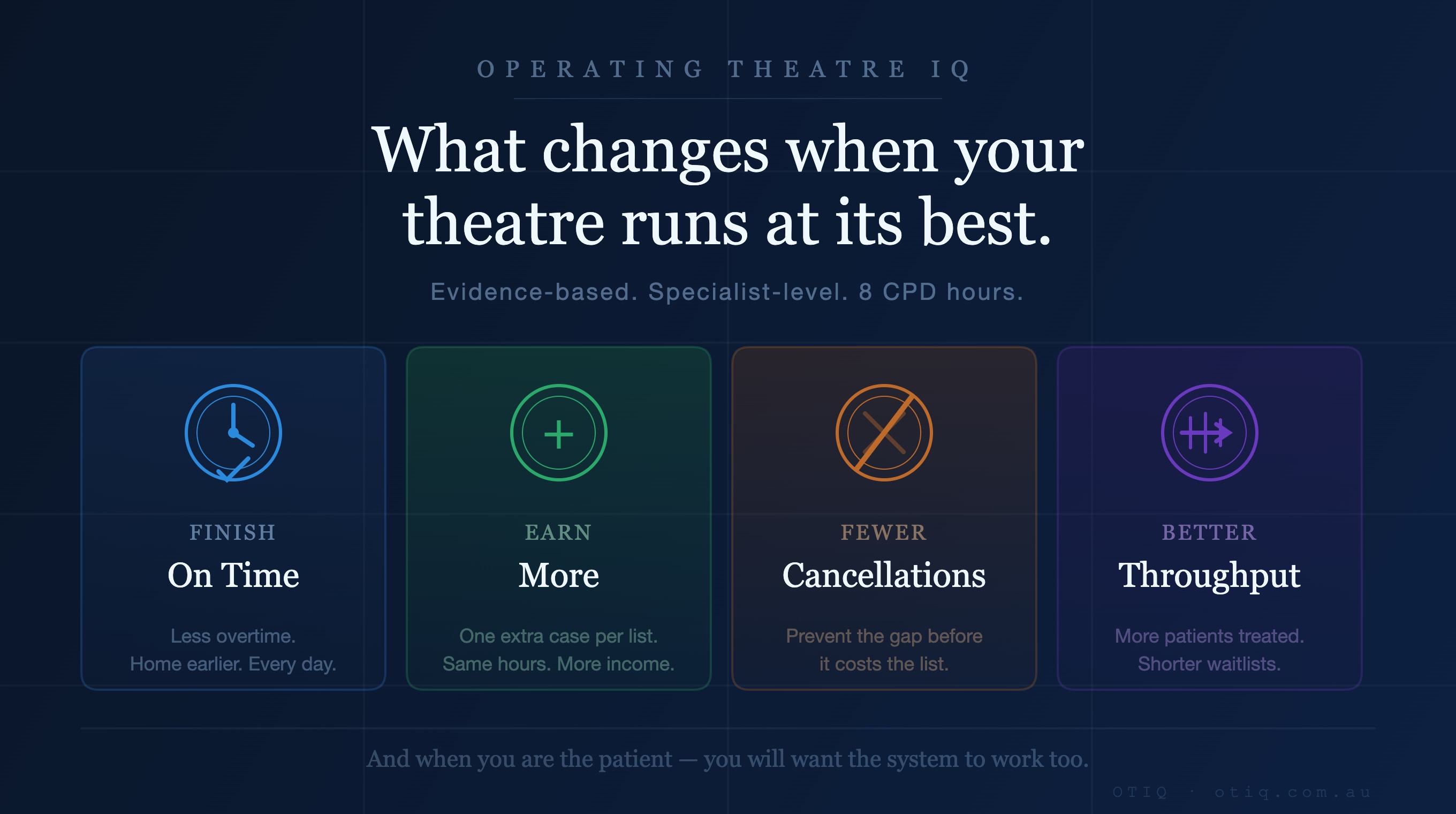
Every minute lost in an operating theatre is a minute a patient waited for nothing. Operating Theatre IQ is a specialist-level CPD course built for clinicians and perioperative professionals who want to understand — and improve — how operating theatres actually work. Developed by a specialist anaesthetist with direct experience of the inefficiencies that cost lists cases, clinicians income, and patients time, this course translates the best available evidence on theatre efficiency into practical, immediately applicable knowledge. It covers the full perioperative system: from booking and list design through to PACU flow, cultural safety, human factors, and the financial case for doing all of it better.
Who this course is for
Operating Theatre IQ is designed for anyone with a professional stake in how operating theatres perform. Hospitals, health services & perioperative departments - OTIQ can be licensed across an entire hospital or perioperative service, providing relevant staff with a shared approach to theatre efficiency, utilisation, patient flow and perioperative systems. Anaesthetists — consultants in CIC or supervisory roles, private practitioners, and anaesthetic trainees. Surgeons — public and private specialists, surgical trainees, and surgical assistants. Proceduralists — gastroenterologists, interventional cardiologists, respiratory physicians performing bronchoscopy, and interventional radiologists. Perioperative nurses — anaesthetic nurses, scrub and scout nurses, admissions and PACU nurses. Floor coordinators and theatre managers Surgical and bookings coordinators Theatre technicians and ward clerks Medical administrators and hospital executives

Meet Your Instructor
Operating Theatre IQ was developed by Dr Sandeep Rakhra, a specialist anaesthetist and Fellow of ANZCA with 10 years of experience across public and private perioperative practice in Australia. Alongside his clinical training, he holds a postgraduate qualification in clinical education. The course was created to close a practical gap: the evidence on theatre efficiency is extensive, but much of it is difficult to translate into day-to-day perioperative work. Operating Theatre IQ turns that evidence into practical frameworks, scenarios, and decision tools that perioperative teams can apply immediately. The course draws on peer-reviewed literature, Australian clinical guidance, publicly available health-system data, and real perioperative practice. Financial figures are derived from publicly available Australian data and are presented as indicative examples. The scenarios reflect common problems encountered in Australian operating theatres.
Course Curriculum
-
-
(Included in full purchase)
MAXIMISING SURGICAL THEATRE EFFICIENCY: A PRACTICAL COURSE FOR PERIOPERATIVE TEAMS
-
(Included in full purchase)
-
-
(Included in full purchase)
INTRODUCTION TO THEATRE SYSTEMS AND GENERAL PRINCIPLES
-
(Included in full purchase)
MCQs
-
(Included in full purchase)
-
-
(Included in full purchase)
STAKEHOLDERS AND INCENTIVE ALIGNMENT — WHO BENEFITS FROM THEATRE EFFICIENCY, AND WHY IT MATTERS
-
(Included in full purchase)
MCQs
-
(Included in full purchase)
-
-
(Included in full purchase)
PATIENT-CENTRED OUTCOMES — HOW THEATRE EFFICIENCY AFFECTS CLINICAL CARE
-
(Included in full purchase)
MCQs
-
(Included in full purchase)
-
-
(Included in full purchase)
HOW TO SCHEDULE AND BOOK A THEATRE LIST
-
(Included in full purchase)
MCQs
-
(Included in full purchase)
-
-
(Included in full purchase)
THE FINANCES OF THEATRE EFFICIENCY — WHAT ONE EXTRA CASE PER DAY ACTUALLY MEANS
-
(Included in full purchase)
THE PICTURE FOR INDIVIDUAL ANAESTHETISTS AND SURGEONS
-
(Included in full purchase)
MCQs
-
(Included in full purchase)
-
-
(Included in full purchase)
MEASURING WHAT MATTERS — UTILISATION, THROUGHPUT, AND THE THEATRE DASHBOARD
-
(Included in full purchase)
MCQs
-
(Included in full purchase)
-
-
(Included in full purchase)
DAY OF SURGERY — PLANNING, PREPARATION, AND CANCELLATION PREVENTION
-
(Included in full purchase)
MCQs
-
(Included in full purchase)
-
-
(Included in full purchase)
FLOWCHART OF THEATRE TURNOVER — THE COMPLETE INTRA-THEATRE WORKFLOW
-
(Included in full purchase)
MCQs
-
(Included in full purchase)
-
-
(Included in full purchase)
OPTIMISING ADD-ON EMERGENCY CASES AND MANAGING EARLY LIST FINISHES
-
(Included in full purchase)
MCQs
-
(Included in full purchase)
-
-
(Included in full purchase)
BARRIERS TO TURNOVER — ROLES, TASKS, AND THE FLOW EQUATION
-
(Included in full purchase)
MCQs
-
(Included in full purchase)
-
-
(Included in full purchase)
BLOCKED PACU — CAUSES, CONSEQUENCES, AND SOLUTIONS
-
(Included in full purchase)
MCQs
-
(Included in full purchase)
-
-
(Included in full purchase)
THE ANAESTHETIST IN CHARGE (CIC) — ROLE, RESPONSIBILITIES, AND SYSTEM LEADERSHIP
-
(Included in full purchase)
MCQs
-
(Included in full purchase)
-
-
(Included in full purchase)
THE THEATRE FLOOR COORDINATOR — THE OPERATIONAL NERVE CENTRE
-
(Included in full purchase)
MCQs
-
(Included in full purchase)
-
-
(Included in full purchase)
THE HUMAN FACTOR IN THEATRE EFFICIENCY
-
(Included in full purchase)
MCQs
-
(Included in full purchase)
-
-
(Included in full purchase)
TECHNOLOGY FOR THEATRE EFFICIENCY
-
(Included in full purchase)
-
-
(Included in full purchase)
CULTURAL SAFETY AND PERIOPERATIVE EFFICIENCY
-
(Included in full purchase)
MCQs
-
(Included in full purchase)
Reflection question
-
(Included in full purchase)
-
-
(Included in full purchase)
MCQs
-
(Included in full purchase)
-
-
(Included in full purchase)
REFERENCE CARDS
-
(Included in full purchase)
FAQs
Who is this course designed for? This course is designed for specialist anaesthetists, surgeons, proceduralists, anaesthetic and surgical trainees, floor coordinators, perioperative nurses, theatre technicians, bookings coordinators, and hospital administrators — anyone with a professional stake in how operating theatres perform. How many CPD hours can I claim? The course supports a total suggested claim of 8 hours — 6.5 hours in the Knowledge and Skills category and 1.5 hours in the Reviewing Performance category. The cultural safety module is designed to align with the Cultural Safety and Addressing Health Inequities domain requirement. The human factors content is designed to align with the Professionalism domain requirement. Is this course formally accredited? Formal accreditation has not been received by any college. It has been developed by a Fellow of ANZCA and is designed to support CPD claims across multiple categories. Candidates should record this activity in their CPD portfolio based on their own assessment of the content and their college's current requirements. How long will I have access? You have 12 months of access from the date of enrolment. All content updates within that period are included. Do I need to complete the modules in order? We recommend working through the modules in sequence as the content builds progressively. However you are welcome to navigate directly to modules most relevant to your current practice. Will I receive a certificate? Yes. A CPD certificate is issued automatically once you complete all 16 modules, the cultural safety reflective practice question, and pass the final assessment at 70% or above. The certificate is available immediately from your dashboard and is also emailed to you. Does the cultural safety module satisfy the mandatory CPD domain requirement? The cultural safety module is designed to align with the at least one CPD activity in the Cultural Safety and Addressing Health Inequities domain. It does not satisfy the separate cultural safety education requirement for new specialist registration applications. Is the course relevant to public hospital practice as well as private? Yes. The course addresses both public and private settings explicitly — including activity-based funding, public hospital overtime costs, and the differences in financial incentives between the two systems. Is a tax invoice provided? Yes. A tax invoice is generated automatically for every purchase. If you require an invoice for CME budget reimbursement or expense purposes contact [email protected] and we will send one directly. Can I complete the course on my phone or tablet? Yes. The course is accessible via the Thinkific mobile app on iOS and Android, or via any mobile browser at otiq.com.au. Thinkific saves your progress automatically, so you can work through a module between cases, pick up where you left off during a break, and complete the course in whatever increments suit your schedule. For the best experience with infographics and the final assessment, a tablet or desktop is ideal — but the course is designed to fit around a clinical day, not the other way around. How quickly will I receive support if I have a question? We aim to respond to course and administrative enquiries within 3–5 business days. OTIQ is a self-paced online course rather than a real-time support service, so response times may occasionally extend during leave or conference periods. For technical issues with the Thinkific platform, [email protected] is the best point of contact. Can I contact OTIQ about a specific efficiency problem at my hospital? The course is designed to give you the frameworks and evidence to work through those problems yourself — that is genuinely its purpose. We are not able to provide individual site-specific consulting or operational advice as part of course enrolment, but we are always happy to hear from participants about how they are applying the content. If you have a question about the course material itself, get in touch at [email protected]. Do you offer access for hospitals, health services and perioperative departments? Yes. OTIQ is available through an institutional licence, providing 12 months' access for relevant perioperative staff across a hospital or perioperative service. This can include anaesthetists, surgeons, nursing staff, theatre technicians, managers, booking staff and surgical clerks. Institutional pricing is based on the number of commissioned operating theatres rather than the number of individual learners, allowing broad access without additional per-user fees. Institutional pricing: First 5 theatres: $2,400 per theatre Theatres 6–15: $1,400 per additional theatre Theatre 16 onwards: $800 per additional theatre Minimum annual institutional licence: $7,500 + GST Pricing is cumulative. For example, a 10-theatre service is $19,000 + GST per year, while a 20-theatre service is $30,000 + GST per year. Multi-site health services can contact OTIQ to discuss group access and pricing.
Finish earlier. Treat more. Earn more.
Hospital and department pricing: Pricing based on number of theatres in your hospital. Contact for details. Individual pricing: Consultants AUD$795. Trainees AUD$249 with code TRAINEE249. Nurses and other staff AUD$149 with code ALLIED149
$795.00